WATCH THE VIDEOS

Hank Kim
Hank Kim

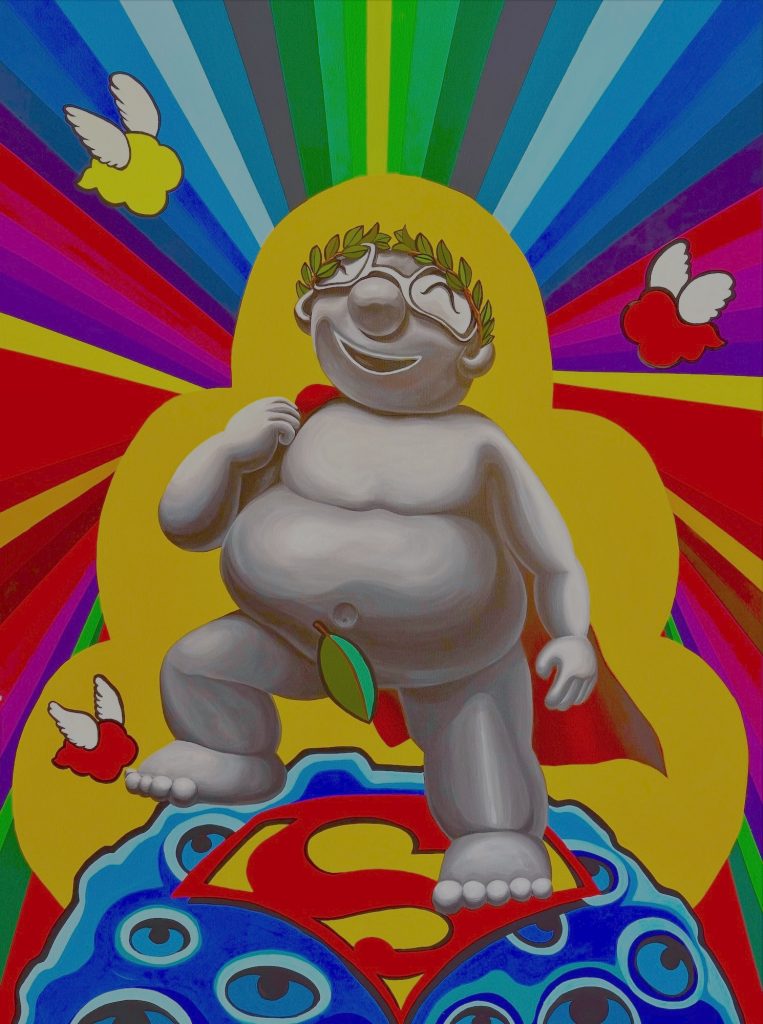
Hank Kim (b. 1972)’s art is rooted in “Everyday Life Aesthetics,” drawing on vernacular histories and blending personal perspectives. Super Babies are on view, configured in bold proportions with sharply defined silhouettes. The aesthetic employs a minimal vocabulary to explore symbols of power. Through solid forms rendered in vibrant colors on sleek, durable surfaces, Kim distills ideas and references into basic forms. Whimsical and highly sculptural, these animated cels become relics of moments such as a single flight or eventual arrival. Minwha is a Korean folk art genre from the late Joseon Dynasty that subtly mocks the rigid aristocracy through lively colors and humor. Kim grafts these traditional Korean Pop Art motifs into modern sculpture—honest depictions of daily life and a desire to transcend reality as a superman. This anti-hero manifests his journey as an immigrant, family man, and artist. Kim’s work is built on memories of Danchung and the Obangsaek—the Korean five-color scheme. It represents a collective desire for cosmic harmony, stability, and peace, incorporating Western art influences and American Pop Art. It also reflects his embrace of life’s mud, a Japanese notion of wabi-sabi—finding beauty in imperfection—and Nietzsche’s Übermensch, which seeks self-mastery and dominance. While Kim’s approach champions life’s humble beauty, it ultimately points to hope and positivity. David Super Baby echoes in its vividness and flatness an arc toward a contemporary aesthetic. Hank Kim has held numerous solo exhibitions and has participated in over 300 group exhibitions. He earned a BFA in painting from Suwon University, an MFA in painting from Sungshin University, and an MFA in sculpture from Lehman College, CUNY. He lives and works in New Jersey.

The 61st Venice Biennale is themed ‘In Minor Keys.” Korean artists working abroad are responding to this theme head-on. For the artists featured here, life itself was the subject of the 2026 Venice Biennale. We visited their exhibitions to explore their diasporic lives and journeys, as well as their work: *Poise and Punchline*, on view from September 11 to November 7, and *Epic Tales*, Yang Soon-yeol’s solo exhibition, running from September 12 to November 15. Jennifer Baahng of Jennifer Baahng Gallery in Manhattan, New York, curated both exhibitions, which are independent programs held alongside the Biennale.

‘In Minor Keys’ and ‘Korean Contemporary Art”

Jennifer Baahng conceived *Poise and Punchline* as a response to the Biennale’s theme. For the late Koyo Kouoh, who envisioned the 61st Biennale, minor keys were more than a register of strangeness and melancholy. Joy, solace, hope, and transcendence also take root within them, bringing about a kind of “retuning”—a return to sensation, emotion, and subjectivity amid the noise of crisis and spectacle. Minor keys are a space for resilience, resistance, and connection. From this lower register, the exhibition draws out two pillars of Korean aesthetics: refinement and humor. Dignified restraint and subversive wit do not oppose one another; they coexist. Humor that does not shout but conceals a sharp edge within laughter resonates with the mood of the minor key.

Korean contemporary art is situated within this framework. Humor is a profound philosophical foundation of Korean culture and art, a philosophy from below that has sustained Korean creative practice. Working in sculpture, installation, and painting, the artists show that humor and sophistication are not opposites but tools for social critique and emotional resonance. Their voices, each artist the author of their own story, come together like the “polyphonic gathering” Kouoh described. They preserve their sovereign dignity while delivering pointed punchlines to the global contemporary art discourse.

In the end, depth travels farthest

In Venice, Korean artists shift the ground without raising their voices. The laughter of folk painting, the memory of pansori, the breath of ink and hanji, Braille made of LEGO bricks, and a universe reflected in a mirror reverberate across the city. These distinct voices do not merge into a single note; they form a harmony while retaining their individual timbres. This fall, Korean contemporary art in Venice proves that what runs deepest travels farthest. *Poise and Punchline* welcomes visitors through November 7, and *Epic Tales* through November 15. For inquiries, visit BAAHNG.COM. The punchline has already been delivered. All that remains is to lower our ears and listen.

Categories: press

Tags: