EPIC TALES

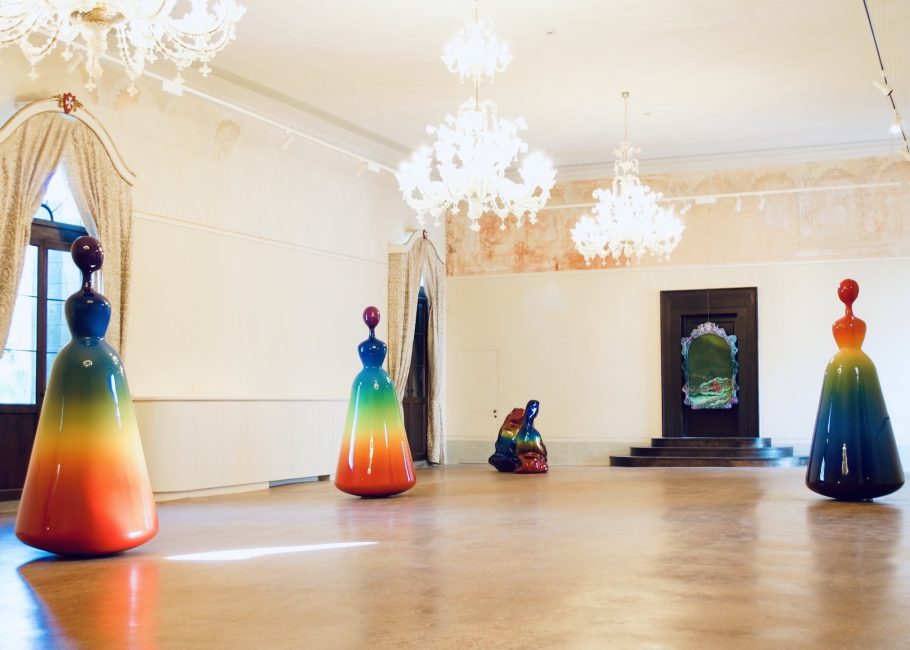
A Yang SoonYeal The Ottogi, 2022 Chrome-finish automotive paint on aluminum-copper alloys (duralumin) 100 × 100 × 230cm, each 39.3 × 39.3 × 90.5 inches, each

Yang SoonYeal

Epic Tales

Curated by Dr. Jennifer Baahng

September 12 – November 15, 2026

VENICE, ITALY — BAAHNG PROJECTS is pleased to present Epic Tales, the first major solo exhibition in Venice by South Korean artist Yang SoonYeal, curated by Dr. Jennifer Baahng. Set within the historic State Rooms of the Sovrano Militare Ordine di Malta, the exhibition offers a strategic immersion at the intersection of the domestic subconscious and the infinite cosmos. As an independent parallel program to the 61st Venice Biennale, the installation serves as a metaphysical crucible, probing the friction between historical gravity and future suspension. The exhibition inquires into intersubjectivity, specifically the profound emotional and psychological resonance between the human condition and the primordial environment. Epic Tales enters the global discourse on metamorphosis, inviting a definitive Surrealist journey through the cosmic maternal.

Yang Soonyeal’s oeuvre reconfigures the progenitor archetype within a rigorous humanist framework, positioning the biological impulse to care as a sophisticated ethical response to contemporary existential fragmentation. Her practice operates at the intersection of monumental surrealism and ontological inquiry, moving beyond cultural specificity to address the universal tension between human interiority and cosmic vastness. The Elysium functions as a conceptual threshold—a portal into a subconscious landscape of transcendence. Within this metaphysical space, the Ottogi serves as a structural anchor. Rather than a mere symbol of resilience, it acts as a gyroscope for the psyche, providing the equilibrium needed to navigate the gravity of internal descent.

The Architecture of Resilience

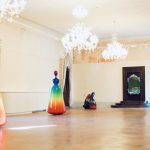
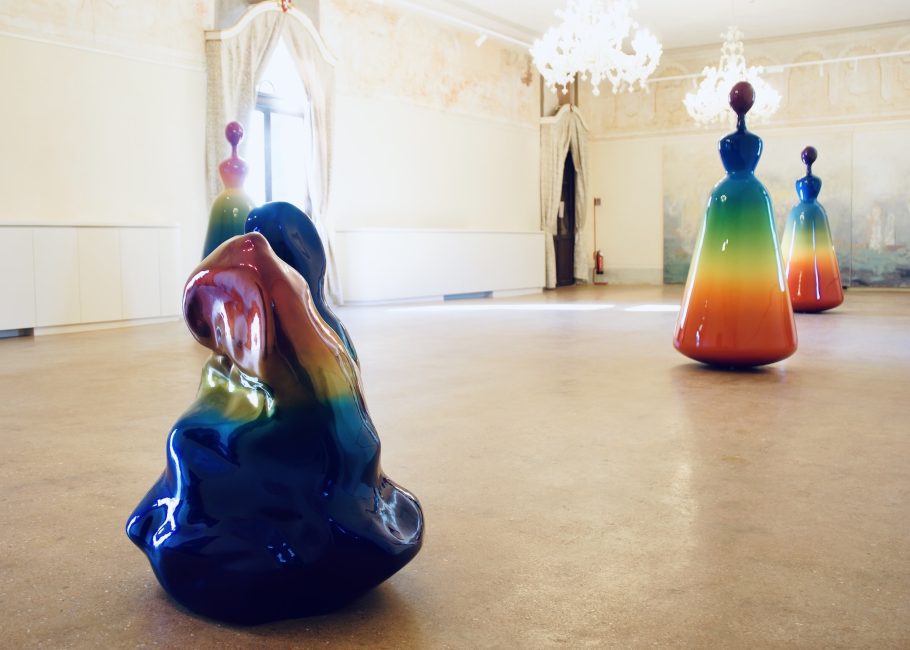
At the heart of the exhibition are the Ottogi—large-scale, ovoid figures finished in high-gloss automotive lacquer. Yang transforms the traditional Korean oddugi, a roly-poly toy, into a clinical archetype of structural resilience. In Venice’s shifting light, these sleek, vibrant forms serve as grounding anchors, embodying the life force that sustains equilibrium within a dreamlike reality.

The Prismatic Aperture

Surrounding the sculptures is The Elysium—mirrors housed in a salvaged classical frame, unified by a prismatic finish. In Yang’s hands, the mirror is stripped of vanity and repositioned as a “Teum”—a tactical portal to another dimension. Through mixed media, including graphite, charcoal, and reflective resins, these mirror paintings dissolve the viewer’s reflection into cosmic nebulae and spiritual landscapes.

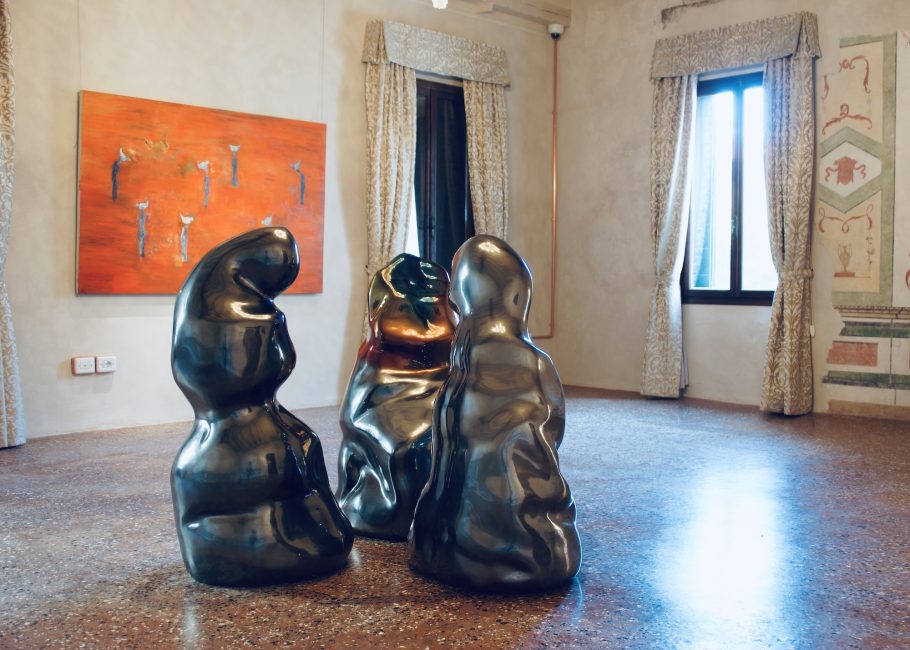
Epic Tales orchestrates a sophisticated spatial dialogue between Yang’s monolithic sculptures and her specular interventions, synthesizing a site-specific “temple” that interrogates the temporal friction between historical gravity and future suspension. At the center of this inquiry is the Ottogi, re-contextualized not as a folk object but as a formalist study in equilibrium. These monumental volumes serve as an ontological anchor, their structural persistence a counterweight to the Elysium. Yang SoonYeal uses the mirror as a medium of phenomenological disruption, dissolving the boundary between the viewer’s physical reality and a fractured, surrealist interiority. The interplay between the murals’ solid mass and the mirror’s liminal presence creates a curated heterotopia. Epic Tales challenges the viewer to reconcile the atavistic weight of human history with the incorporeal weightlessness of an impending, digitized future.

EXHIBITION VIDEO

Play Video

ABOUT THE ARTIST

Yang SoonYeal (b. 1959) maintains a multidisciplinary practice spanning painting, sculpture, and performance, dedicated to exploring the cyclical nature of genesis and dissolution. Yang’s work serves as a phenomenological bridge, synthesizing traditional motifs with a contemporary surrealist vernacular. By leveraging monumental scale and specular surfaces, she creates immersive environments that prompt confrontation with transience and permanence. Yang was featured in articles and reviews by Beom-Mo Yoon, former director of the National Museum of Modern and Contemporary Art; Enju Choi, current director of the Seoul Museum of Art; art critic Lilly Wei; and the late Robert C. Morgan in New York. Selected Korean online press articles include Chosen Ilbo, Munhwa Ilbo, Dong-A Ilbo, SBS, and Naver.Com. Her latest institutional presence, including the Gyeonggi Museum of Modern Art and the gallery at the National Assembly of the Republic of Korea, underscores her role in elevating local cultural signifiers into a universalist humanist discourse.


WATCH THE VIDEOS

Hank Kim
Hank Kim

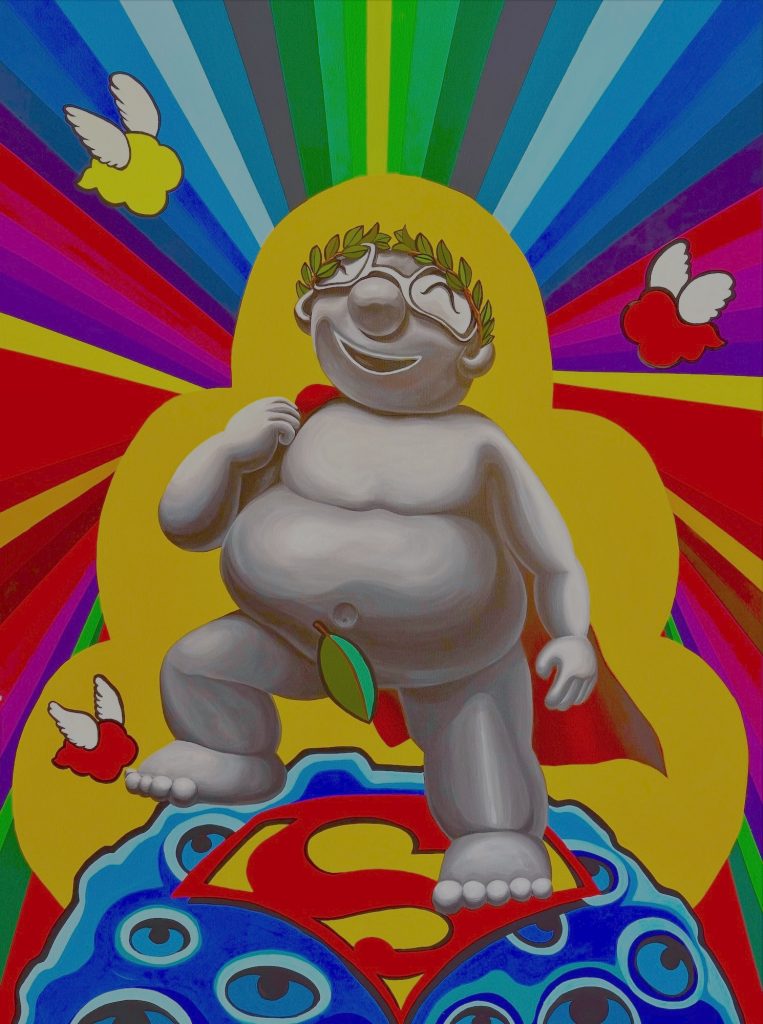
Hank Kim (b. 1972)’s art is rooted in “Everyday Life Aesthetics,” drawing on vernacular histories and blending personal perspectives. Super Babies are on view, configured in bold proportions with sharply defined silhouettes. The aesthetic employs a minimal vocabulary to explore symbols of power. Through solid forms rendered in vibrant colors on sleek, durable surfaces, Kim distills ideas and references into basic forms. Whimsical and highly sculptural, these animated cels become relics of moments such as a single flight or eventual arrival. Minwha is a Korean folk art genre from the late Joseon Dynasty that subtly mocks the rigid aristocracy through lively colors and humor. Kim grafts these traditional Korean Pop Art motifs into modern sculpture—honest depictions of daily life and a desire to transcend reality as a superman. This anti-hero manifests his journey as an immigrant, family man, and artist. Kim’s work is built on memories of Danchung and the Obangsaek—the Korean five-color scheme. It represents a collective desire for cosmic harmony, stability, and peace, incorporating Western art influences and American Pop Art. It also reflects his embrace of life’s mud, a Japanese notion of wabi-sabi—finding beauty in imperfection—and Nietzsche’s Übermensch, which seeks self-mastery and dominance. While Kim’s approach champions life’s humble beauty, it ultimately points to hope and positivity. David Super Baby echoes in its vividness and flatness an arc toward a contemporary aesthetic. Hank Kim has held numerous solo exhibitions and has participated in over 300 group exhibitions. He earned a BFA in painting from Suwon University, an MFA in painting from Sungshin University, and an MFA in sculpture from Lehman College, CUNY. He lives and works in New Jersey.
Categories: new-project

Tags:

Interview Epic Tales by VENEWS

logo

WATCH THE VIDEOS

Hank Kim
Hank Kim

Hank Kim (b. 1972)’s art is rooted in “Everyday Life Aesthetics,” drawing on vernacular histories and blending personal perspectives. Super Babies are on view, configured in bold proportions with sharply defined silhouettes. The aesthetic employs a minimal vocabulary to explore symbols of power. Through solid forms rendered in vibrant colors on sleek, durable surfaces, Kim distills ideas and references into basic forms. Whimsical and highly sculptural, these animated cels become relics of moments such as a single flight or eventual arrival. Minwha is a Korean folk art genre from the late Joseon Dynasty that subtly mocks the rigid aristocracy through lively colors and humor. Kim grafts these traditional Korean Pop Art motifs into modern sculpture—honest depictions of daily life and a desire to transcend reality as a superman. This anti-hero manifests his journey as an immigrant, family man, and artist. Kim’s work is built on memories of Danchung and the Obangsaek—the Korean five-color scheme. It represents a collective desire for cosmic harmony, stability, and peace, incorporating Western art influences and American Pop Art. It also reflects his embrace of life’s mud, a Japanese notion of wabi-sabi—finding beauty in imperfection—and Nietzsche’s Übermensch, which seeks self-mastery and dominance. While Kim’s approach champions life’s humble beauty, it ultimately points to hope and positivity. David Super Baby echoes in its vividness and flatness an arc toward a contemporary aesthetic. Hank Kim has held numerous solo exhibitions and has participated in over 300 group exhibitions. He earned a BFA in painting from Suwon University, an MFA in painting from Sungshin University, and an MFA in sculpture from Lehman College, CUNY. He lives and works in New Jersey.
The Time of a Breath

Interview with Yang SoonYeal | Epic Tales

by Mariachiara Marzari, Nov 3, 2026

A multidisciplinary artist whose work spans painting, sculpture, and performance, Yang SoonYeal (born 1959, South Korea) explores the world’s cyclical nature and transformations. She is the subject of her first major solo exhibition in Venice. This is a special opportunity to discover her art, a perfect synthesis of traditional motifs and contemporary surrealist language, composed of contrasts that dissolve into a perception of a universal dimension. In Epic Tales, curated by Jennifer Baahng and hosted in the historic State Rooms of the Sovereign Military Order of Malta, Yang SoonYeal orchestrates a sophisticated spatial dialogue between monumental, monolithic sculptures and mirrored surfaces, creating an immersive environment that seems peaceful and suspended, yet is in fact deeply shaped by the passage of time—between history and the future, permanence and transience. Epic Tales invites visitors on a surrealist journey in which the search for profound emotional and psychological resonance unfolds through the encounter between the human condition and the primordial environment.

Yang SoonYeal’s words below reveal a layered personal world in constant motion, making her art a harmonious yet ever-evolving language. On view through November 15, Epic Tales is truly one of those exhibitions not to be missed.

Categories: press

Tags:

ART WORLD reviews Poise and Punchline in November 2026

art world logo

WATCH THE VIDEOS

Hank Kim
Hank Kim

Hank Kim (b. 1972)’s art is rooted in “Everyday Life Aesthetics,” drawing on vernacular histories and blending personal perspectives. Super Babies are on view, configured in bold proportions with sharply defined silhouettes. The aesthetic employs a minimal vocabulary to explore symbols of power. Through solid forms rendered in vibrant colors on sleek, durable surfaces, Kim distills ideas and references into basic forms. Whimsical and highly sculptural, these animated cels become relics of moments such as a single flight or eventual arrival. Minwha is a Korean folk art genre from the late Joseon Dynasty that subtly mocks the rigid aristocracy through lively colors and humor. Kim grafts these traditional Korean Pop Art motifs into modern sculpture—honest depictions of daily life and a desire to transcend reality as a superman. This anti-hero manifests his journey as an immigrant, family man, and artist. Kim’s work is built on memories of Danchung and the Obangsaek—the Korean five-color scheme. It represents a collective desire for cosmic harmony, stability, and peace, incorporating Western art influences and American Pop Art. It also reflects his embrace of life’s mud, a Japanese notion of wabi-sabi—finding beauty in imperfection—and Nietzsche’s Übermensch, which seeks self-mastery and dominance. While Kim’s approach champions life’s humble beauty, it ultimately points to hope and positivity. David Super Baby echoes in its vividness and flatness an arc toward a contemporary aesthetic. Hank Kim has held numerous solo exhibitions and has participated in over 300 group exhibitions. He earned a BFA in painting from Suwon University, an MFA in painting from Sungshin University, and an MFA in sculpture from Lehman College, CUNY. He lives and works in New Jersey.
The 61st Venice Biennale is themed ‘In Minor Keys.” Korean artists working abroad are responding to this theme head-on. For the artists featured here, life itself was the subject of the 2026 Venice Biennale. We visited their exhibitions to explore their diasporic lives and journeys, as well as their work: *Poise and Punchline*, on view from September 11 to November 7, and *Epic Tales*, Yang Soon-yeol’s solo exhibition, running from September 12 to November 15. Jennifer Baahng of Jennifer Baahng Gallery in Manhattan, New York, curated both exhibitions, which are independent programs held alongside the Biennale.

‘In Minor Keys’ and ‘Korean Contemporary Art”

Jennifer Baahng conceived *Poise and Punchline* as a response to the Biennale’s theme. For the late Koyo Kouoh, who envisioned the 61st Biennale, minor keys were more than a register of strangeness and melancholy. Joy, solace, hope, and transcendence also take root within them, bringing about a kind of “retuning”—a return to sensation, emotion, and subjectivity amid the noise of crisis and spectacle. Minor keys are a space for resilience, resistance, and connection. From this lower register, the exhibition draws out two pillars of Korean aesthetics: refinement and humor. Dignified restraint and subversive wit do not oppose one another; they coexist. Humor that does not shout but conceals a sharp edge within laughter resonates with the mood of the minor key.

Korean contemporary art is situated within this framework. Humor is a profound philosophical foundation of Korean culture and art, a philosophy from below that has sustained Korean creative practice. Working in sculpture, installation, and painting, the artists show that humor and sophistication are not opposites but tools for social critique and emotional resonance. Their voices, each artist the author of their own story, come together like the “polyphonic gathering” Kouoh described. They preserve their sovereign dignity while delivering pointed punchlines to the global contemporary art discourse.

In the end, depth travels farthest

In Venice, Korean artists shift the ground without raising their voices. The laughter of folk painting, the memory of pansori, the breath of ink and hanji, Braille made of LEGO bricks, and a universe reflected in a mirror reverberate across the city. These distinct voices do not merge into a single note; they form a harmony while retaining their individual timbres. This fall, Korean contemporary art in Venice proves that what runs deepest travels farthest. *Poise and Punchline* welcomes visitors through November 7, and *Epic Tales* through November 15. For inquiries, visit BAAHNG.COM. The punchline has already been delivered. All that remains is to lower our ears and listen.

Categories: press

Tags:

WE ARE THE LAND

WE ARE THE LAND

Yang SoonYeal

Forbidden Fruits

May 19 – June 30, 2026

WATCH THE VIDEOS

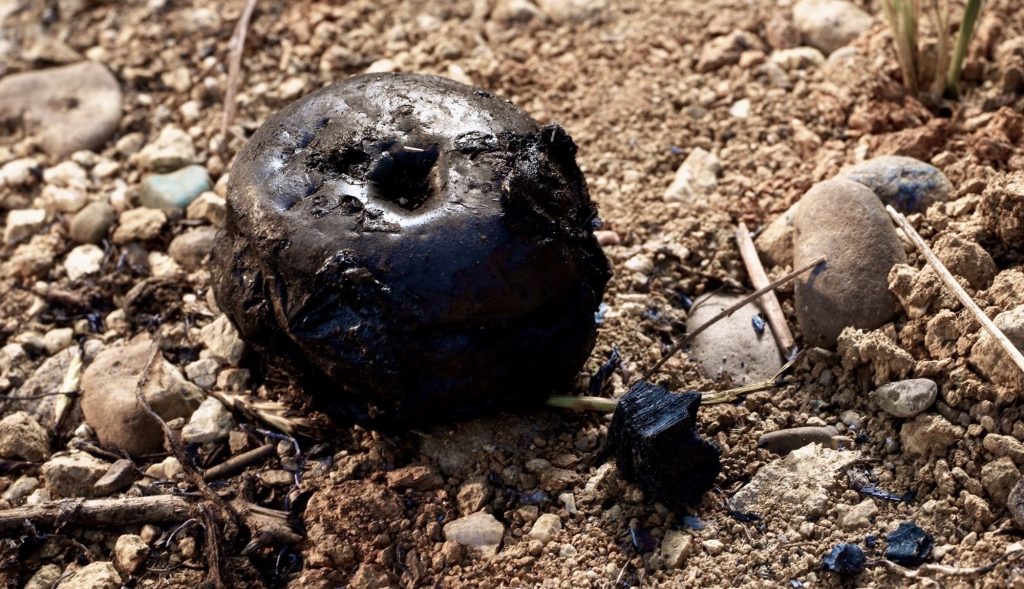
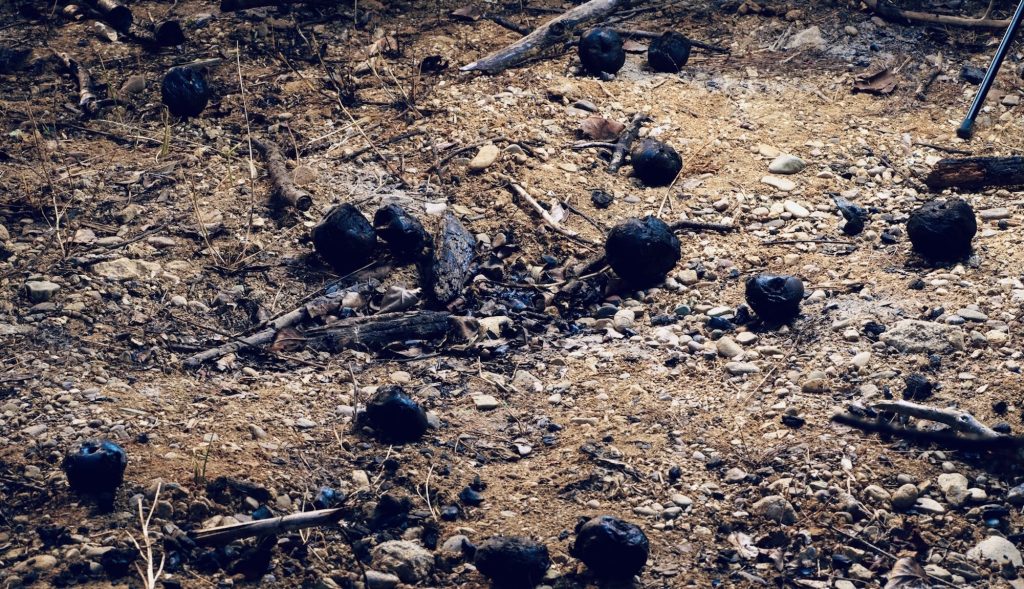
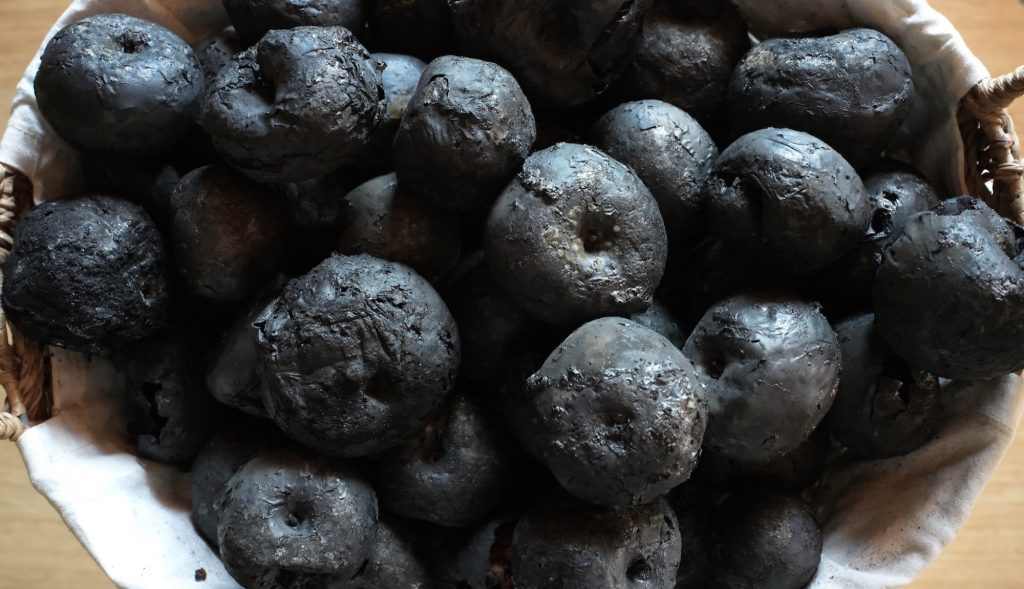
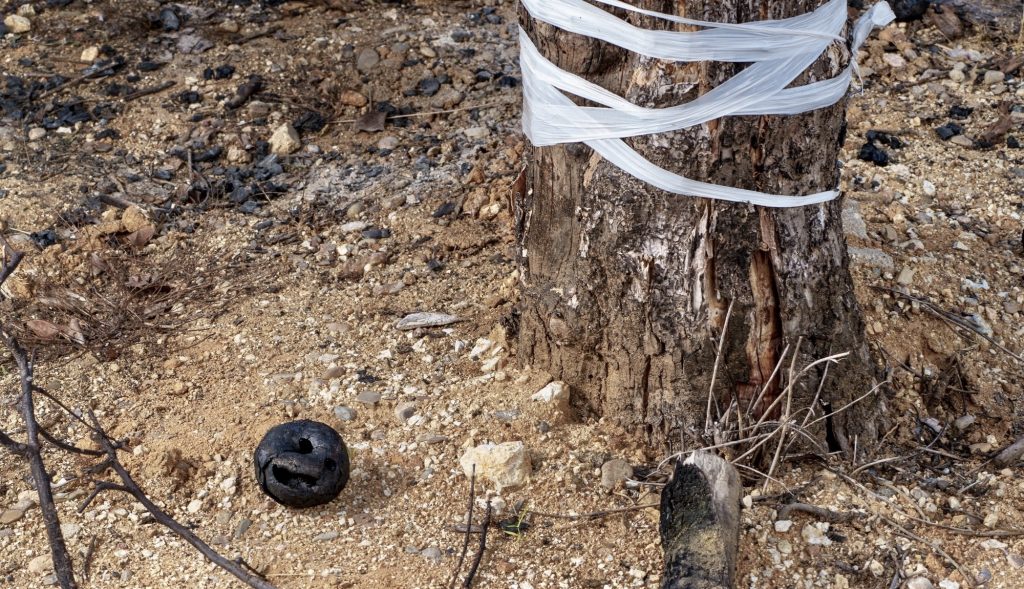
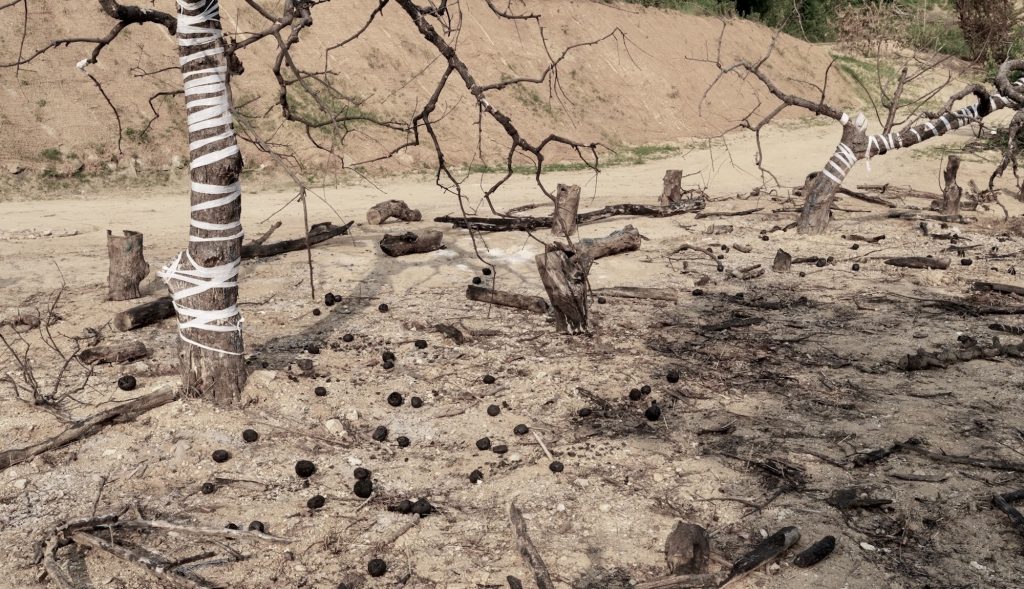
JENNIFER BAAHNG’s curatorial initiative WE ARE THE LAND presents Forbidden Fruits, which explores the complex relationship between human actions and the physical environment through Yang SoonYeal’s burnt apples collected after a 2025 wildfire in South Korea. The online exhibition illustrates ecological and domestic destruction, revealing how human actions scar the land. Forbidden Fruits is a social sculpture, a transformative artistic concept coined by Joseph Beuys in the 1970s, which proposes that society itself is a collective artwork shaped by individuals’ creativity, actions, and thoughts. “Everyone is an artist,” in structuring society, fostering dialogue, and enacting social change. Showcasing charred apples as art shifts the focus from the aesthetic perfection of traditional fruit paintings to the messy, often overlooked processes of change and loss. Forbidden Fruits is a living sculpture, a Gesamtkunstwerk that focuses on transformation, transience, and the imperfections of reality.

In the humanities and visual culture, the apple shifted from a strict scriptural code to a dynamic vector for formalist, phenomenological, and semiotic experimentation. Originally bound to a Latin philological pun (malus denoting both fruit and evil), the motif long cast the apple as a rigid biblical archetype of original sin. Modernism, however, dismantled this theological shorthand to interrogate human consciousness and perception. Within still-life painting, the apple became a primary laboratory for radical innovation: CĂ©zanne deployed the fruit to shatter Renaissance perspective, introducing a multi-perspectival geometry that undergirded Cubism. Van Gogh subsequently leveraged the motif to exploit simultaneous contrast, privileging visceral, chromatic expressionism over mimesis. Inverting this painterly lineage, Magritte engineered an aesthetic disruption that exposed the semiotic instability of the visual image. By decoupling the signifier from the signified, Magritte’s deadpan treatment bypassed traditional aesthetics, forging the intellectual matrix that codified Conceptual Art and the mass-media ironies of Pop Art.

Extending this trajectory from the gallery wall into contemporary eco-discourse, introducing Forbidden Fruits into Land Art offers a profound thermodynamic critique of the Anthropocene, staging an intellectual convergence among history, culture, and the physics of ecological ruin. By subjecting the apple to the entropic violence of fire, Land artists perform a literal and symbolic decolonization of the landscape. The blackened apples function as a site-specific archive of pyrocene trauma, in which the orchard’s domestic comforts are violently reclaimed by elemental, unruly natural forces. Structured within the landscape, these carbonized spheres evoke the geological minimalism of Robert Smithson and the ephemeral cyclicality of Andy Goldsworthy, serving as a visceral memento mori. This practice establishes a compelling material dialectic: the scorched apple is both a relic of total destruction and an essential biological nutrient that fuels future micro-ecosystems. Ultimately, this framework redefines the burnt apple from a passive object of aesthetic decay into an active, political agent of generative ruin, exposing the fragile, porous boundaries between human cultivation and climate-induced collapse.

WE ARE THE LAND: Forbidden Fruits bridges material alchemy, classical mythology, and contemporary socio-ecological collapse. Yang SoonYeal’s practice orchestrates an ultimate semiotic rupture by upending the apple’s historic iconography as the fruit of paradise, refracting it instead through the lens of environmental destruction. As a living monument to the Pyrocene, these carbonized spheres crystallize the literal memory of climate trauma. The burnt apples are conceptually diamondized into hardened, permanent sculptures—simultaneously beautiful and horrific—that transmute an ephemeral eco-catastrophe into a haunting, static aesthetic object. Operating as a Beuysian social sculpture, Forbidden Fruits fosters active ecological literacy by linking anthropogenic action directly to systemic planetary health. Foraging among these contemporary ruins, Yang laments the collapse of a stable Holocene world while seeking a persistent impulse within the ash, the green buds of an Earth sprouting from the site of its own destruction.

Categories: exhibitions

Tags: